
Shaping a Safety Culture
By Andrew D. ShamRao, Ph.D., President, Divaker Ltd.
Contents
The Evolution of a Safety Culture
Shaping Employee Perceptions
Basic Compliance Systems
Losing Employee Confidence
Shifting Attitudes
Self-Directed Safety Compliance System
Behavioral Safety System
Conclusion
Some companies worry that a focus on safety invariably will detract from production. This does not have to be the case.
The culture of a business is influenced by the dynamic tension between four fundamental business factors. These are productivity, quality, cost, and safety. The main question that should be addressed in designing a corporate culture is "how can we facilitate safe, quality production?"
After all, without production, the business would not exist. Safety without meeting quality production goals eventually will kill the business. Meeting quality production goals without safety is likely to kill or injure employees.
The culture we want to shape is characterized by behaviors that focus on safe, quality production and ensure safety for everyone. This culture, called the "want-to" safety culture, is the outcome of a collaborative effort between management and workers. It can be cultivated by positively reinforcing behaviors and results that make progress towards it. The goal is to create a culture in which safety permeates all activities.
Three systems are necessary for the evolution of an organization's collective behavior towards a "want-to" safety culture.
The Evolution of a Safety Culture
The evolution of a "want-to" safety culture contains three main developmental systems. The first of these is what I call the basic compliance system, which ensures that safety training programs, work conditions, procedures, and processes comply with OSHA regulations and company rules and policies. This is passive or structural compliance because it does not address the individual's specific actions.
Next, is the self-directed safety compliance system, which involves workers in the task of ensuring regulatory compliance, and encourages them to take personal responsibility for making use of training and other regulatory provisions. This system emphasizes active compliance with regulations.
Finally, the behavioral safety system introduces a process for teaching individuals to scan for hazards, to focus on the potential injuries and the safe behavior(s) that can prevent them, and to act safely.
The three systems comprise a comprehensive process for building a want-to safety culture. An assessment can reveal at what evolutionary step an organization's safety culture is. It also can reveal what needs to be done to facilitate the organization's progress towards a want-to safety culture.
Sidebar: The Evolution of a Corporate Culture
By Andrew ShamRao, Ph.D., President, Divaker Ltd.
The nature of human potential is that it must be nurtured, guided, and exemplified. Full potential rarely spontaneously appears. Rather, it evolves from and grows into its own expression. The process by which human potential is realized is called shaping.
In the science of behavior analysis, shaping is the act of guiding the evolution of behavior towards some predetermined final form. Behavior is shaped successfully by positively reinforcing progress towards that form. Shaping an organization's culture involves similar requirements, because culture is the collective behavior of a community of individuals. First, we must define the kind of culture we want. Then, we must design the developmental steps necessary to help an existing culture evolve into the desired one.
Organizational cultures evolve in different directions depending on leadership style and what business factor leaders emphasize. The values of an organization are based on what is important to its leaders. If leaders emphasize productivity, those who report to them will build structures that are likely to perpetuate the behaviors that satisfy the leaders' emphasis. As these behaviors spread throughout the organization, the culture evolves to take on a specific flavor.
The evolutionary step at which an organization's culture is will define the attitudes of employees towards the company, company property, and other workers. These attitudes will be observable in what people do and what they say to each other. Thus, in designing the developmental systems that will help a culture evolve, one must also consider employee perceptions, because perceptions prompt behavior, and repeated behaviors become habits and take on attitudinal labels.
The pyramid illustrates the conceptual framework that is the basis of the three developmental systems for helping an organization evolve towards a want-to safety culture. It also indicates, starting with the base, what must be addressed first in order to shape employee perceptions and support for the safety process.
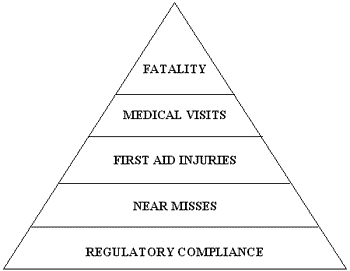
Notice that the base of the pyramid is regulatory compliance. At a minimum, basic compliance with regulations demonstrates to employees that the company is committed to safety. This baseline performance on the company's part is necessary to begin shaping the attitudes of employees in the direction of the want-to safety culture.
The self-directed component of a safety culture capitalizes on workers' positive perceptions about the company's commitment to safety and begins to involve workers in the regulatory process. In this way, a positive perception about their ability to affect safety is shaped in employees. At some point in the evolutionary process, employees begin to feel empowered to manage safety.
Ensuring basic and self-directed safety compliance makes it easier to apply behavioral methods to address safety. Behavioral safety methods should be used to minimize the occurrence of near misses. A near miss is any event that could have resulted in injury, but didn't, because of some behavior the individual did to keep safe. Based on the conceptual framework presented in the safety pyramid, minimizing near misses will minimize first aid injuries, medical emergencies, and fatalities. A behavioral safety system should measure near misses and reinforce acting safely.
Shaping a safety culture and shaping employee perceptions go hand in hand. A failure to monitor perceptions can slow cultural shaping. The three components discussed in this article were designed to ensure that employee experiences shape a positive perception about the organization and aid in the evolution of the culture rather than hinder it. The order in which the developmental systems should be implemented will depend, to some extent, on where the current culture is along the evolutionary continuum.
Shaping and cultivating a positive employee perception about a company's concern for safety starts with basic regulatory compliance. At a minimum, the organization must appoint a safety coordinator whose responsibilities include learning the applicable regulations, instituting systems to facilitate compliance, devising a system for monitoring compliance, and building a relationship with regulatory bodies such as OSHA or EPA.
A basic compliance system accomplishes two objectives. First, it makes some fundamental safety items and training available to all employees. Second, it can build employee confidence in the company's concern for their safety.
The act of appointing an individual to a safety position alone may be sufficient to initially create the perception that the company cares about employee safety. However, workers' subsequent experiences will determine whether that perception is accurate. If the organization's commitment to safety is found to be lacking in action, this discovery can have a damaging impact on management-worker relations, and can result in a lack of trust in the organization.
Many kinds of experiences can shatter employee confidence in the organization's concern for safety. For example, let us assume that soon after establishing basic compliance, a supervisor asks Tom, a new employee, to operate a forklift without receiving appropriate training.
When Tom makes the supervisor aware of his lack of training, the supervisor responds that because of production demands, he will show him the basics, and next week, Tom can go through the formal training. Tom feels a little uncomfortable but goes along with the supervisor's suggestion for fear of angering him. Being a new employee, Tom gives the company the benefit of doubt, but suspects that safety is important to the company as long as production is not hampered.
A month goes by and Tom still has not been given formal training in operating a forklift. He asks his supervisor about it, and the supervisor responds by asking him whether he had hurt himself driving the forklift in the last month. Tom says "no," to which the supervisor replies: "See? You don't need the training. You know how to operate the machine."
In relating the story to others, Tom discovers that they too have experienced similar events with their supervisors. What Tom suspected initially is now a fact for him: production gets priority over safety. His perception that the company cares about safety is replaced with mistrust, suspicion, and a diminished loyalty.
In these situations, many employees shift from a "want-to" attitude to a "have-to" attitude with regard to company safety policies. This attitude usually prompts people to violate or abide by company policies depending on who is watching. The more widespread the "have-to" attitude, the more likely that it will become a cultural trait.
In a "have-to" safety culture, two perspectives are prevalent. One is that safety is the responsibility of the organization. The second is that safety is the responsibility of the worker.
The former perspective is prevalent among employees in organizations that either do little to improve work conditions and processes, or fail to follow-through on verbal commitments to safety. Workers who experience these conditions develop the attitude that the organization does not care for their wellbeing. They often express bitterness when the organization attempts to put a behavioral process in place that emphasizes worker behavior as the key to safety.
That safety is the responsibility of the individual is a perspective held by many safety professionals and consultants. According to this perspective, no matter what work conditions and processes are improved, unless individuals act safely, they will be injured. Therefore, the focus should be on encouraging people to act safely under any circumstances, because we can never be in a hazard-free environment. The onus is on the worker, not the organization.
Self-Directed Safety Compliance System
In most organizations, the roles of management and employees are usually separated. Management is typically responsible for regulatory compliance and employees are usually held responsible for their behavior. The ideal situation, however, is one in which management and workers collaborate on regulatory compliance issues.
A culture that uses self-directed safety compliance uses a team approach to manage regulatory compliance. The team consists of workers, supervisors, and managers. These individuals learn how to monitor and manage the compliance of the safety-training program, work conditions, and work processes with state and federal regulations. They learn to develop compliance monitoring tools and to deliver safety training to co-workers.
A self-directed safety compliance system strengthens basic compliance because team effort affords workers greater access to regulatory provisions. Team effort also increases the efficiency of addressing regulatory issues and of delivering training. With these two systems as a foundation, completing the evolution towards a safety culture by establishing a behavior safety system is easier and worthwhile.
Where before, the safety coordinator shouldered the responsibility for ensuring that everyone had received the necessary safety training, self-directed workers are empowered and encouraged to take charge of their own compliance with training regulations. This system implements the concept of empowerment in safety and further shapes the perception that safety involves a personal commitment.
Even after safety training, there is no guarantee that a trainee will work safely. The temptation to take shortcuts is fueled by past experiences in which similar activities were done successfully and injury-free using risky shortcuts. Another factor that fuels risk-taking is that the methods specified in training for doing work often take more time, and can be cumbersome. In this age of time consciousness and decreasing cycle times, a slow safety procedure is likely to fall by the wayside.
The absence of injuries leads many managers to conclude that people are working safely. This is a faulty and dangerous assumption because the absence of injuries could be because people got lucky. By making such an assumption, managers inadvertently submit safety to luck. The only way to know if people are working safely is to measure it. A behavioral safety system can motivate people to act safely, and show that safe behavior, not luck, is responsible for safety.
Employees who are confident in the company's commitment to safety will be more open to participating in a behavioral safety system. In such a system, the burden of success rests on employees' participation. However, employee participation in this process is not guaranteed. Employee commitment to the behavioral safety system will require shaping their experiences, and therefore their perceptions about the value of participating in the process.
Time is a precious commodity, and people want to know that the amount of time they spend on an activity, however small, will have tangible outcomes. Therefore, the first principle in building a safety process is the KISS principle: Keep It Simple Sam. In keeping with this principle, the activity required of participants in the behavioral safety process must not take more than 2-3 minutes per day.
The second principle is: Design an experience for the participant that demonstrates value for the time they spend doing the behavioral-safety activity. The components of a behavioral-safety system include: pinpointed safe behaviors, a measurement tool for tracking those behaviors, a feedback system to provide information useful for improving performance, and a positive reinforcement system to motivate people to do the safe behaviors and to record their occurrences. If one of these components is missing, the behavioral system will be compromised.
While all behavioral systems have these components, behavioral consulting companies differ in the methods used to implement each component. A successful methodology for implementing the four components will focus on ensuring relevant safety behaviors. Second, it will focus on the measurement of at least three key indicators of success, namely what portion of the group is using the process (participation), how widely is it being used by each individual (generalization), and whether injury rates are decreasing (improvement). Third, it will have a process for regular feedback and reinforcement sessions based on data.
Thus, relevant safe behaviors, a clear connection between participation and improved or maintained safety, and reinforcement for working safely and meeting milestones will establish the value of the behavioral safety process.
If you want your behavioral safety system to be successful, allow individuals to practice generalizable safe behaviors. Generalizable safe behaviors are those that can be applied to any situation, at anytime and anywhere. These behaviors include scanning the environment for hazards, focusing on the potential injuries and on the safe behavior(s) that can prevent them, and acting safely. Scanning, focusing, and acting safely become habits when applied repeatedly in a variety of situations chosen by the individual. Thus, this process promotes choice and flexibility for the performer and thereby enhances the relevance and value of the safety tool.
Another way to increase the perceived value of the process is to help individuals realize the benefits of using it. Make employees aware of the potential injuries that they are avoiding by doing the safe behavior. This is an important component of the process, because it increases the likelihood of a person doing the safe behavior. For example, if an employee actively thinks about the third degree burns he could get if molten metal splashed on his unprotected body, then he is more likely to put on his personal protective equipment to avoid being injured.
A third way to promote value in the process is to share and celebrate the impact of participation and generalization on the overall safety performance of the facility. Feedback and reinforcement systems that use the data people spend time collecting will enhance the value of that activity. One type of data to collect involves work conditions and processes that need to be fixed, upgraded, or replaced. The process will gain value in the eyes of workers if the self-directed safety compliance team gives timely feedback to the group about actions being taken to address reported issues.
Shaping a safety culture involves taking deliberate steps to guide the evolution of a culture towards one characterized by a concern for personal and others' safety. It is only when all three systems are in place—basic compliance, self-directed safety compliance, and behavioral safety—that a company can hope to achieve a corporate culture that is based on safe production.
BIO: Andrew ShamRao is president of Divaker Ltd., Chicago, IL, a behavioral consulting company. He specializes in designing pinpointing, measurement, reinforcement, recognition, reward, and feedback systems to help improve human performance. ShamRao has consulted with companies such as Hewlett Packard, Dow Chemical, AMOCO Corp., and Shell Western on applying behavioral methods to issues including accountability, cultural transformation, employee and customer loyalty, performance based compensation systems, and industrial and non-industrial production, quality, timeliness, cost, and safety issues. He can be reached by phone at (773)525-9685, or by e-mail at andrew-shamrao@divaker.com.